A business credit score helps lenders, suppliers, and other companies assess the credit risk associated with your business. Depending on the scoring model, it may summarize past payment behavior or estimate the likelihood of future payment problems.
You might first hear about it when a supplier offers payment terms, a lender reviews an application, or you check your company’s credit report. Suddenly, a number you have never paid much attention to becomes part of an important business conversation.
The good news is that you do not need to become a credit expert to understand the basics. You need to know which score you are looking at, what information sits behind it, and what you can reasonably do next.
How Does a Business Credit Score Work?
A commercial credit bureau collects information about a business and uses a scoring model to evaluate it. The information may come from suppliers, financial institutions, and public records. Different providers can have different information about the same company.
A score offers a quick assessment. The underlying report gives the details: which company the file belongs to, what accounts have been reported, and whether payment problems appear in its history.
That is why you should read the report alongside the number. A score without its model, scale, and supporting information is easy to misunderstand.
Source: Equifax: How small-business credit data is collected.
Is Business Credit the Same as Personal Credit?
Personal credit relates to your financial history as an individual. Business credit relates to the company’s credit profile. However, building a business profile does not automatically remove the owner from a financing decision.
The U.S. Small Business Administration notes that loan eligibility for a new business is typically based on the owner’s personal credit score. Depending on the product, lenders may also request a personal guarantee.
For a fuller explanation, read our guide to business credit vs personal credit.
Source: SBA: Planning your business and establishing credit.
What Are the Main Business Credit Scores?
There is no single score used for every business or every decision. Two names you may encounter are D&B PAYDEX and Experian Intelliscore Plus. Equifax also provides commercial credit information and risk assessments.
Dun & Bradstreet PAYDEX
PAYDEX focuses on a business’s historical payment performance. Dun & Bradstreet describes its scale as 1–100, with higher scores indicating stronger payment performance. Its published risk categories place scores of 80–100 in the low-risk group for late payment.
PAYDEX is dollar-weighted, so the size of reported payment experiences matters. It is not simply a count of how many invoices you paid.
Source: Dun & Bradstreet: Understanding PAYDEX.
Experian Intelliscore Plus
Experian Intelliscore Plus uses a 1–100 scale to assess the risk of seriously negative payment behavior. Higher scores represent lower risk. Experian’s published categories place 76–100 in its low-risk group.
That does not make an Experian score of 80 interchangeable with a PAYDEX score of 80. The models and their interpretations differ.
Source: Experian: Business credit risk rankings.
Equifax Commercial Credit Information
Equifax business reports can include payment trends, public-record information, and risk indicators. Check the name and explanation of the specific score on your report rather than assuming it follows another provider’s scale.
Source: Equifax: What makes up a commercial credit score?.
| Provider/model | Main point for beginners |
| D&B PAYDEX | Focuses on reported historical payment performance |
| Experian Intelliscore Plus | Estimates the risk of seriously negative payment behavior |
| Equifax commercial reports | Review the particular risk indicator and its accompanying explanation |
What Affects Your Business Credit Score?
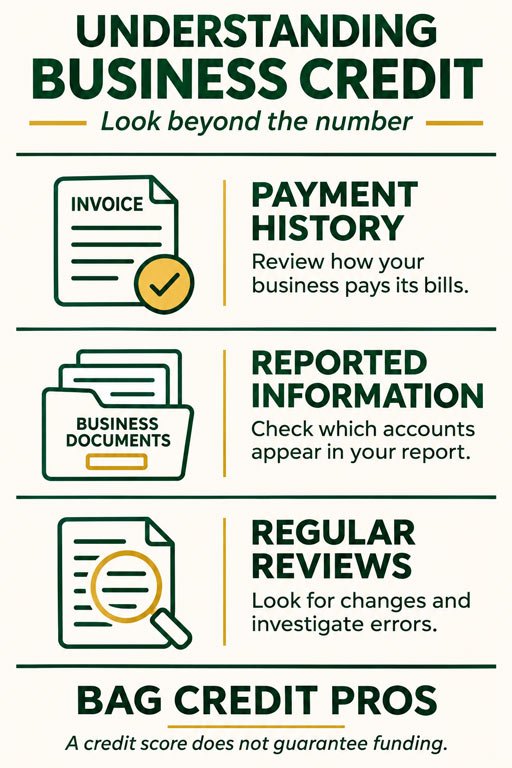
The answer depends on the model. For example, Experian identifies payment habits, outstanding balances, credit utilization, trade experiences, certain public records, years on file, industry classification, and business size among its scoring factors.
This helps explain why paying on time, although important, may not tell the entire story. A report can reflect more than one part of your company’s financial history.
There is no universal formula that lets you assign a guaranteed point increase to a particular action. If a provider supplies key score factors, start there: those explanations are more useful than generic advice about chasing a number.
Source: Experian: Understanding your business credit score.
Why Do Business Credit Scores Matter?
Your company’s credit profile may influence whether a supplier extends credit, what terms it offers, or how a potential business partner evaluates the relationship. It can also be part of a lender’s review.
Imagine two companies asking a supplier for 30 days to pay an invoice. One has a visible record of timely payments; the other has very little information available. The supplier may want more information from the second company before extending terms.
This is a hypothetical example, not a prediction of how any particular supplier will decide. Its purpose is to show why a documented track record can matter even outside a loan application.
Source: Dun & Bradstreet: Business credit scores and ratings.
How Can You Check Your Business Credit Score?
Start with the provider whose information you want to review. Before selecting a report or monitoring service, check:
- Which bureau and scoring model it includes.
- Whether you receive a full report or only a summary.
- The price, renewal terms, and cancellation conditions.
- How recently the information was updated.
When reviewing the report, first confirm that it belongs to your business. Then examine the reported accounts, balances, payment history, and score explanations.
Keep a dated note of anything you do not recognize. A specific question—such as whether an account belongs to another company—is easier to investigate than a general concern that the score looks low.
Why Might a New Business Have No Score?
An empty or limited credit file is different from a poor payment history. A new company may not yet have enough reported information for a particular bureau to calculate a score.
Also, paying a supplier does not necessarily mean the payment will appear in a bureau’s records. Reporting arrangements vary.
For PAYDEX specifically, Dun & Bradstreet explains that unreported payment experiences cannot be included in the score. Ask a supplier which bureau it reports to and when it typically submits information, rather than assuming every account will help build every profile.
How to Start Building a Stronger Business Credit Profile
Keep Your Business Identity Consistent
Use accurate business information across accounts and applications. Keep your legal business name, contact information, and relevant registration details current.
An EIN helps identify your business, but obtaining one is not the same as establishing a payment history. For the setup process, see our guide on how to build business credit with an EIN.
Choose Accounts Your Business Actually Needs
Before opening a trade account, consider the product, price, repayment terms, and reporting arrangements. An account should make sense for your operations, not just appear on a credit-building checklist.
For example, do not buy unnecessary office supplies simply because a vendor advertises credit reporting. Useful purchasing and responsible repayment should come first.
Build a Reliable Payment Routine
Record invoice due dates when bills arrive. Assign responsibility for payments and use reminders or appropriate automatic payments, while checking that sufficient funds are available.
Review Progress and Correct Mistakes
Check your business file periodically and investigate unfamiliar entries. A clean administrative routine is more useful than repeatedly checking a score without addressing the underlying information.
Dun & Bradstreet recommends timely payments, monitoring, and establishing a business identity as part of building business credit. It also notes that there is no standard timeline for establishing a file.
Source: Dun & Bradstreet: Establishing and building business credit.
What Should You Do If Your Report Contains an Error?
Use the commercial bureau’s official correction process and identify the specific information you believe is inaccurate. Keep relevant statements, payment confirmations, and correspondence available.
For example, Experian provides a “Submit Data Dispute” option within its business reports. Follow its current instructions and retain confirmation of your request. Correcting information does not guarantee a particular score change.
Source: Experian: Correcting business credit information.
Does a Good Business Credit Score Guarantee Funding?
No. A score does not replace the rest of a financing application. Revenue, cash flow, existing obligations, business history, and the provider’s requirements can still matter.
Business and personal credit can also overlap in an application, especially for startups. Review whether a provider requests personal credit information or a personal guarantee before committing.
If financing is your next goal, explore our business funding information to understand the available pathways and next steps. Approval depends on the provider’s assessment.
Source: Dun & Bradstreet: Where personal and business credit meet.
Frequently Asked Questions
What is a good business credit score?
It depends on the model. For example, D&B places PAYDEX scores of 80–100 in its low-risk category, while Experian’s Intelliscore Plus categories place 76–100 in the low-risk group. Neither category guarantees approval.
Does getting an EIN give my business a credit score?
No. Business identification and reported credit activity are different things. Your company needs sufficient information in the relevant bureau’s file for a score to be available.
Will every vendor account appear on my business credit report?
No. Confirm the supplier’s reporting arrangements. Do not assume that it reports to every bureau or that an account will appear immediately.
How long does it take to build business credit?
There is no fixed timeline. File creation, reported activity, and a provider’s financing requirements are separate milestones.
Your Next Step: Understand the File Behind the Score
Before opening more accounts or submitting another application, find out what your current business credit report says. Identify the model, read the key factors, and choose one practical issue to address.
If you would prefer structured guidance, explore the BAG Credit Pros business credit mentorship program. It is a place to learn more about building a business credit strategy and preparing for future funding conversations.
This guide provides general education about U.S. business credit. Scoring models, reporting practices, and financing requirements vary.
